
The Museum and Gallery Digital Experience Problem: Why Low Adoption Isn't About the Content
The one friction point that's quietly undermining your digital visitor experience

In almost every public space today, people instinctively reach for their phones to navigate, understand and make sense of the world around them. We use maps to orient ourselves, audio to guide us, search to gain context, and digital wallets to pay.
Cultural venues are no different. When visitors are standing in front of an object or trying to work out where to go next, they expect their phone to help.
The question is no longer whether venues should offer digital support. It is whether visitors can actually reach that support in the moment they need it.
Three models for digital experiences in cultural venues
Today, digital is delivered in cultural venues in three distinct ways, each optimised for a different job.
Portfolio apps
Portfolio apps aggregate content from many institutions into a single native app. They are designed to support discovery and content browsing across venues, allowing people to explore collections, save favourites and return to material over time.
They can be used on site for listening to audio or finding object-level content. However, they are not designed as on-site systems. They don't support navigation through a space, maintain spatially aware context, or help visitors move from one moment to the next during a visit.
As a result, visitors are often required to reorient themselves within the app or reselect an institution after putting their phone away, creating friction at precisely the moments when they are trying to move, decide or continue.
Web pages and microsites
Many venues also publish mobile-friendly pages accessed via QR codes. These reduce friction compared to native apps, but they are typically designed as static content pages rather than live, on-site tools. They answer a single question when a visitor scans a code, but they don't follow the visitor through their experience — they can't adapt to where someone is, where they're going, or what they need next.
On-site visitor experience platforms
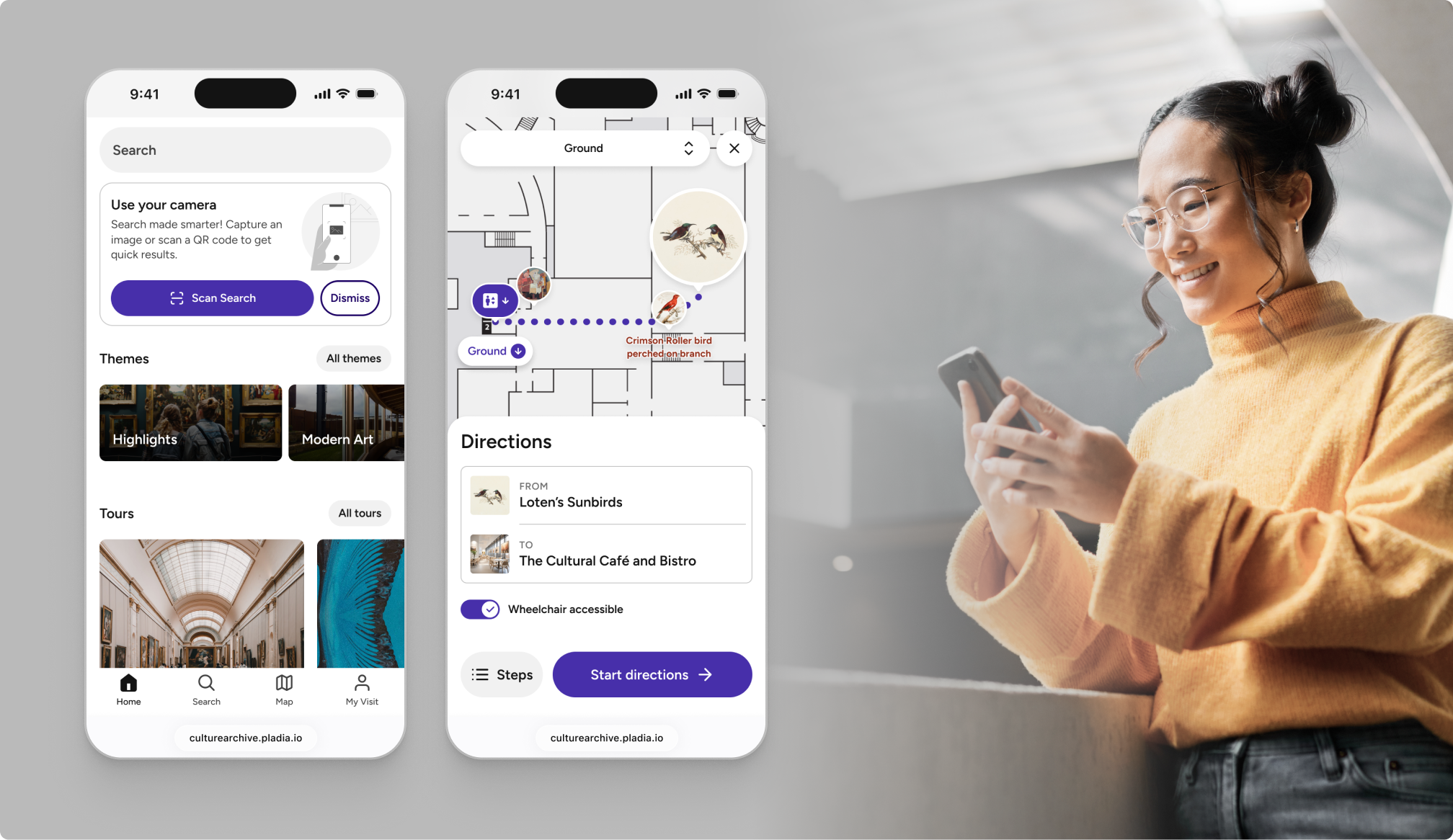
A newer category treats the visitor's phone as part of the physical environment. These platforms combine storytelling, navigation, accessibility and transactions into a single, continuous on-site experience.
Pladia Empower sits in this third category.
The real adoption challenge
Portfolio apps have played an important role in making digital storytelling mainstream. But they face a structural limitation on site.
Once visitors have arrived, downloading an app is no longer a rational decision for most people. They are already navigating, already moving and already using their browser. The perceived cost of downloading an unfamiliar app outweighs the benefit in that moment.
An analysis of 175 native museum audio guide apps across Europe and the United States found that only 2.47% of visitors actually download and use them. This does not reflect the quality of the content. It reflects whether visitors ever reach it in the first place. (Nubart, 2024)
Portfolio apps also require venues to trade control for distribution. Content lives inside someone else's interface. Visitor data is abstracted. Revenue opportunities are limited or shared. That trade-off can make sense for discovery and off-site engagement. It is far less effective for guiding, supporting and serving visitors who are already on site.
What about free? The real cost of zero
For some venues, the conversation starts with a straightforward question: if a portfolio app is free to institutions, why pay for anything else?
The answer lies in what "free" actually delivers. Adoption is the real currency of digital strategy.
Some portfolio apps — Bloomberg Connects is a well-known example — are free to institutions. But free distribution means your venue is one entry in someone else's app — an app that carries another organisation's branding, surfaces your content alongside dozens of other institutions, and determines how (and whether) visitors find you. Your identity, your story and your visitor relationship all sit inside a platform you don't control.
Want to see how Empower and Bloomberg Connects compare directly? See the full breakdown.
Free is only valuable if it gets used. When on-site adoption sits below 3%, the honest conversation isn't about budget — it's about whether your visitors are getting any digital support at all.
The network effect argument — and why it matters less on site
Portfolio apps rightly point to their existing user base as a distribution advantage. The logic is appealing: if visitors already have the app installed from a previous venue, they're more likely to use it at yours.
In practice, this argument is strongest for discovery — finding out about your venue before a visit. And for that job, it has real merit.
But on-site, the dynamic is different. The visitors who matter most in the gallery are the ones in front of you right now, many of whom will be first-time visitors, tourists, or school groups who don't have any particular app pre-installed. For them, the fastest path to engagement is the one with the fewest steps.
Whose brand is it?
There is a subtler cost to shared-app models that rarely makes it into procurement conversations: brand.
When a visitor opens a portfolio app, they are inside that platform's experience. Your venue's identity — its visual language, its voice, the way it wants to present its collection — is mediated through someone else's interface. For many venues, this is an acceptable trade-off for the distribution it brings.
But for institutions that have invested in their own brand, curatorial voice and visitor experience, giving that up is a significant concession. Your visitor experience becomes a feature of another product rather than an expression of your own.
Empower is a themeable platform. The experience visitors see reflects your brand — your name, your logo, your colours — with accessibility compliance built in. There is no Pladia branding in the visitor-facing product. Every digital touchpoint reinforces your identity, not ours.
What makes Empower different
Empower is built on a different premise. If a digital experience requires a download, login or prior planning, most visitors will never use it in the gallery or on the grounds.
Instead, Empower delivers a native-quality experience instantly through the mobile browser. Visitors scan a QR code, tap a link or follow a prompt and they are in — no commitment, no setup, just help when they need it.
It brings together:
→ Instant, no-download access
→ Storytelling and navigation as one experience
→ Indoor and outdoor wayfinding without hardware
→ Audio Access+ for phone-to-ear listening
→ Multi-perspective tours for different audiences
→ Venue-owned branding, data and monetisation
All optimised around one goal: ensuring digital support is available exactly when visitors need it.
A simple way to think about the choice
Portfolio apps help people discover cultural content.
Empower helps people navigate, understand and access it while they are there.
The most valuable digital platforms are not defined by the size of their libraries, or by whether they are free, but by whether they are actually available to visitors at the exact moment support is needed.
Want to see Empower in action? Book a demo to talk to our team.
