.webp)
Building a connected campus experience with Pladia Empower at Peabody Essex Museum
How PEM unified a distributed campus and launched a landmark 200th anniversary experience using Pladia Empower.

Background
Founded in 1799, PEM is America's oldest continuously operating museum and one of its most innovative cultural institutions.
Spread across nearly 130,000 square feet in downtown Salem, Massachusetts, with more than 20 galleries, a dozen historic houses, and a handful of gardens, PEM holds more than 850,000 works spanning African, American, Asian, maritime, Native American, Oceanic, fashion, and natural history collections.
The challenge
For first-time visitors, PEM's campus can feel complex to navigate. Spread across multiple buildings, galleries, historic houses, and outdoor spaces, it rewards those who arrive with a plan and can feel daunting without one. Like most major museums, many visitors are walk-ins, arriving with limited time and looking for a starting point.
The museum's footprint moves between galleries, historic buildings, and an arboretum that extends throughout downtown Salem. Empower offered a way to connect the whole campus, allowing visitors to stay oriented and engaged throughout their journey without relying on a paper map.
Before Empower, PEM offered self-guided audio tours via QR codes that linked to the museum's website: content that was accessible, but connected to distinct physical markers like signage, and not designed to follow a visitor through their visit.
The museum needed to solve three connected challenges:
- helping visitors navigate a campus distributed across multiple neighborhoods of a small city
- connecting experiences thematically across multiple buildings and outdoor spaces
- developing a scalable, evidence-based, iterative method for learning about visitors’ experiences at PEM
The solution
A research-led approach to a connected campus
PEM chose Pladia Empower, a progressive web app accessible through a browser, to create a connected visitor experience across galleries, historic houses, and the green spaces that make up its arboretum, without requiring a native app.
The decision to use Empower emerged from a research collaboration with the Pladia team, built on iterative design and ongoing testing. A central requirement was to give visitors a clear starting point and lightweight wayfinding across the museum campus.
Empower’s role as a digital twin, a connected digital layer that mirrors the physical campus and links the visitor experience across spaces, addressed this need.
Wayfinding and the digital twin
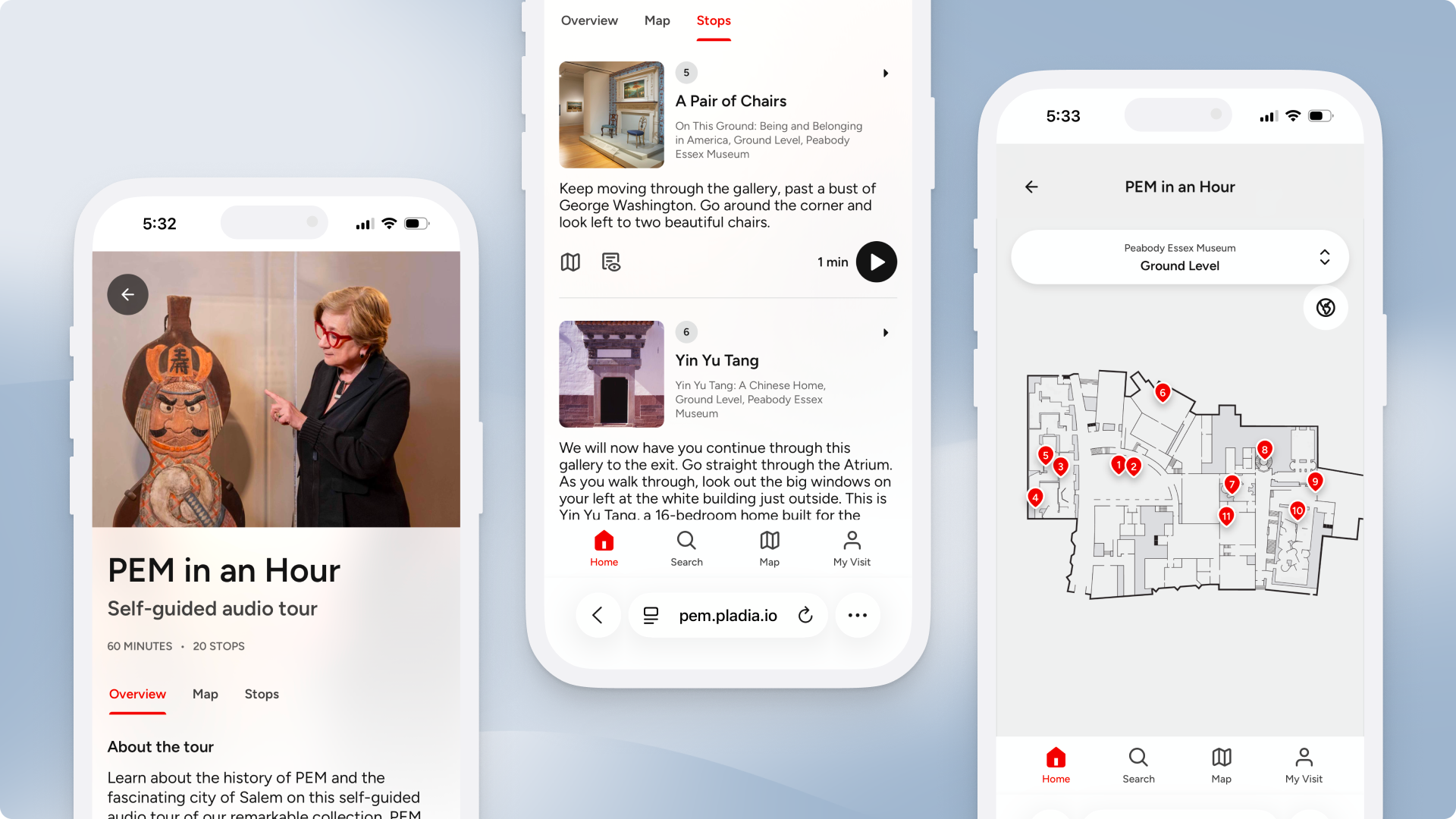
Empower provides a unified map of the full campus, indoors and out. Unlike the museum’s paper maps, visitors can see where they are at any point, get directions to their next stop, or browse what is nearby. This creates a consistent wayfinding layer across galleries, historic buildings, and outdoor routes that extend into downtown Salem, helping visitors orient themselves as they move through the museum’s campus.
Narrative experiences across the collection
Beyond navigation, Empower enables curators to build thematic narratives that connect objects by meaning rather than location. This allows PEM’s collection of more than 850,000 works to be interpreted through themes rather than physical proximity.
Extending the experience beyond the museum
This is most clearly expressed in tours that extend beyond the museum itself. The Salem Witch Trials Walk moves visitors from galleries into the streets of downtown Salem, connecting the collection with real-world locations in a single continuous narrative. Since launch, it has been the most used tour and demonstrates how the digital twin extends across indoor, outdoor, and non-museum spaces in a single journey.
.webp)
A staged, tours-first rollout
Rather than waiting for a fully complete campus-wide launch, PEM took a staged approach to go-live, beginning with three tours in February 2026. This allowed value to be delivered early, while the experience was refined through real-world usage.
Each tour plays a different role in the visitor experience:
- PEM in an Hour, provides a 21-stop overview of the museum’s collection highlights in English and Spanish. It launched with Spanish-language audio at every stop, narrated by Rosario Ubiera-Minaya, a local community leader in the arts.
- Handwork 2026: Craft in America, curated by Curator-at-Large Paula Richter, brings together works from six galleries and around 30 objects, tracing 400 years of handcraft history without requiring a dedicated exhibition. It demonstrates how narrative experiences can be drawn from the permanent collection.
- The Salem Witch Trials Walk, extends the experience beyond the museum walls, connecting gallery objects to sites across downtown Salem and creating a continuous journey through both collection and city.
The staged launch demonstrates how customers can go live without waiting for a full venue rollout, activating existing collections early and building experiences iteratively over time.
A 200-year landmark reopening
At the heart of the museum sits East India Marine Hall. Built in 1824–25, the hall is a National Historic Landmark and home to PEM’s founding collection: objects gathered between 1799 and 1867 by the East India Marine Society, whose members were expected to return with objects from voyages beyond the Cape of Good Hope or Cape Horn.
On 14 March 2026, the hall opened a major new installation marking its 200th anniversary, displaying several hundred founding collection objects through an updated, global lens.
Empower as the primary interpretive layer
As part of the exhibition design, and in a nod to 19th-century museum design, the hall did not include traditional wall labels for individual objects. Empower became the primary interpretive layer in the space, allowing visitors to access object information, context, and audio directly on their devices at the point of experience.
"Helps with details and reexamining objects. A very needed way to hold your interest in this historic room full of treasures."
— PEM visitor
%20(1).webp)
A connected physical and digital experience
The completion of EIMH reconnected visitors with the thread of PEM’s history, offering a conceptual bridge between the galleries, the historic hall, and the streets of Salem.
The Outcome
Visitor engagement and usage
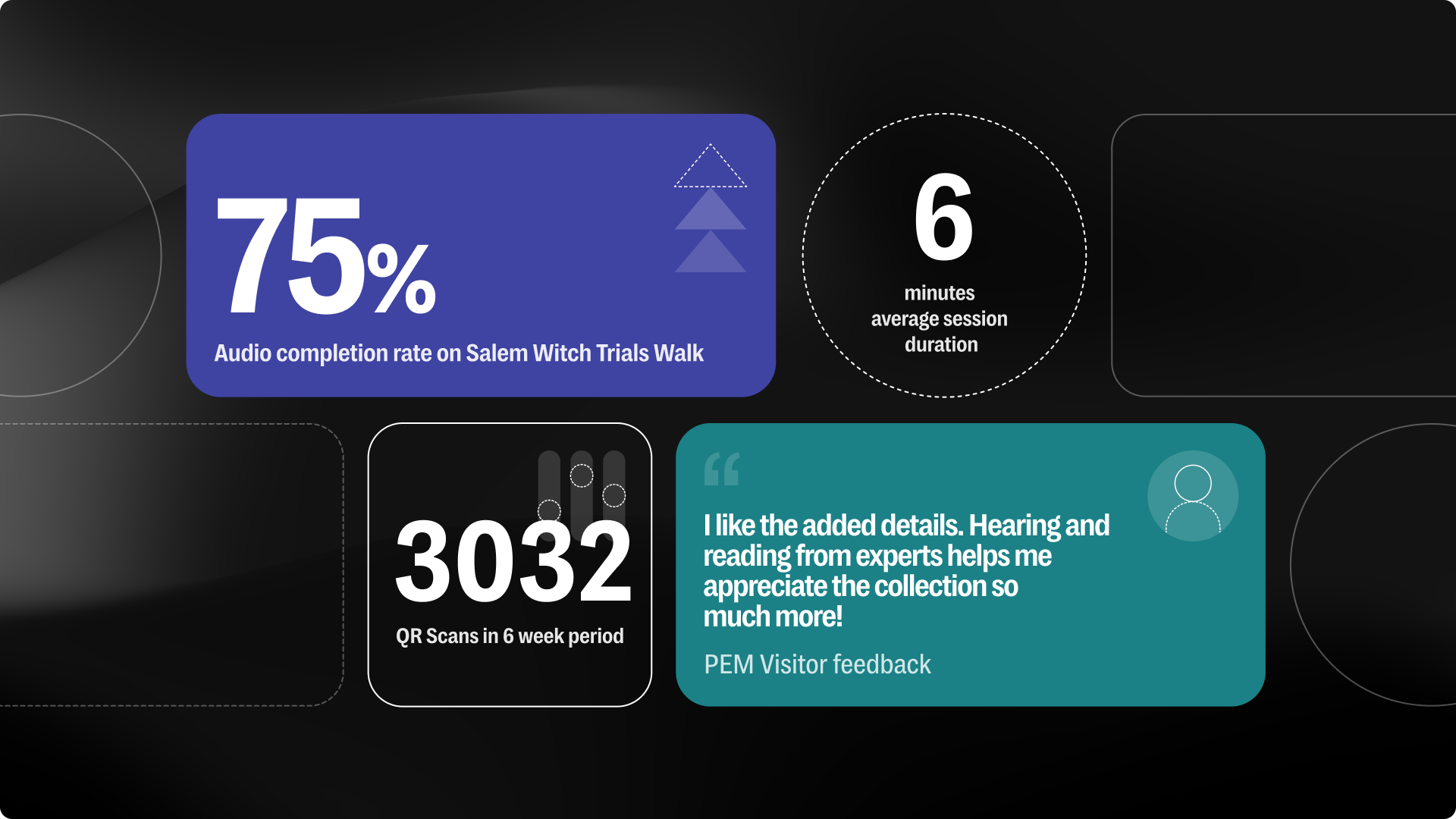
Since the EIMH launch, PEM’s Empower PWA has logged more than 4,000 unique sessions. Visitors are engaging for an average of 6 minutes, time spent exploring content rather than simply scanning a code and moving on.
Across the same period, the three tours recorded more than 4,000 views. The Salem Witch Trials Walk was the most used, accounting for almost half of all engagement, with audio completion rates averaging above 75%.
QR scans and on-site engagement
QR code scans totalled 3,032, driven largely by engagement during the EIMH opening, where object-level scans became a key entry point for visitors.
Expanding curatorial capability
Beyond usage metrics, the platform has expanded what PEM’s curatorial and content teams can create. Craft in America, PEM in an Hour, and EIMH were developed from the permanent collection rather than new exhibitions or acquisitions. The tours and tagging system enables new narratives to be created and deployed iteratively, without requiring structural change to the collection or physical space.
Visitors share their thoughts directly through the PWA:
"I like the added details. Hearing and reading from experts helps me appreciate the collection so much more!" — PEM visitor
"Allowed me to go deeper." — PEM visitor
"This is really fun and interesting! Me and my gang loved it!!" — PEM visitor
“Super helpful to learn more about each object!” — PEM visitor
What's next
PEM's visitor feedback and real-world usage help shape the Pladia roadmap, ensuring the platform continues to evolve alongside the customers that use it.
